Uniforms of the Regiment
A discussion of the Uniforms of the 31st Indiana Vols.
This page discusses the Uniforms of the 31st Indiana Volunteer Infantry soldier. On this page are two (2) different representations of typical 31st Indiana Privates. The first representation is the (early) uniform exhibited with the photos of my Great, Great Grandfather Andrew Gosnell and James N. Sheperd. The second, represents what I believe to be the typical (later) uniform, beginning in 1862 through the end of the war.
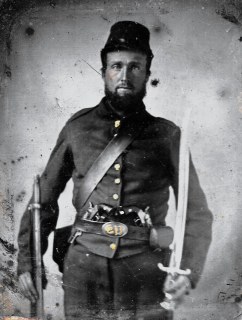
Andrew Gosnell
31st Indiana Co. K
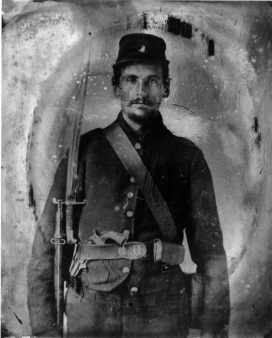
James Sheperd
31st Indiana Co. K
What they are wearing:
Please note that the above photos are reverse (mirrored) which was typical of a tintype photo. Andrew and James are wearing a plain dark blue forage cap, a dark blue blouse or shell jacket with 9 brass buttons and dark blue trousers. What we now call a coat or jacket was called a blouse back then. The jacket has shoulder straps on each side. Both men wear a black leather waist belt with a brass oval "US" belt buckle. Under Andrew's revolver grip on your left can be seen a brass belt keeper. Both have a cap box and cartridge box, probably of Enfield design. The cartridge box is carried using a black belt that hangs off the shoulder opposite the box with the shoulder belt under the waist belt. Andrew has his cartridge box on your left and James' is on your right.For more information on the portraits of Andrew see the "The Portraits of Andrew Gosnell" web page.
Their Arms:
Rifles:
Both Andrew and James have identical rifles and bayonets. The rifles are an Enfield Pattern 1858 Short Rifle also known as a Pattern 1856 No. 2 (See the "Arms of the Regiment " web page for more information on this rifle). Andrew has the top of the barrel facing the camera showing the bayonet lug and the part of the upper ring for the gun shoulder belt. It appears that Andrew's rifle has a leather belt, but James' rifle does not have a belt. James is holding his rifle with the ramrod facing the camera fully showing the upper ring.
Bayonets: Andrew is holding his bayonet and the scabbard for the bayonet can be seen hanging off his waist belt just behind the cap box and following down below the bayonet. James has the bayonet fixed to the rifle. Both bayonets are the Enfield Pattern 1858 Saber-bayonets. Note the Saber-bayonet's distinctive shape.
Revolvers: James has a revolver stuck in his belt that appears to be a .31 caliber Colt Pocket-Pistol model 1849. Andrew has two revolvers in his belt that on first look appear to be Colt Pocket-Pistols, but upon closer examination they are most likely Bacon mfg. Co. "Excelsior" first model pocket-pistol revolvers of .31 caliber, a very rare piece. [1] Revolvers were never issued to enlisted infantry, they would have had to purchase their own or retrieve them from a fallen soldier.
No Photographer Props
:
Could the rifle and pistols be photographer props? I have thought about this possibility and have come to the conclusion that these were their possessions and not props. The reason for this is that it is extremely unlikely that a "very rare" Enfield Pattern 1858 Short Rifle would be owned by a photographer for use as a prop. The colt revolver that James carries, could have been a prop due to its popularity, however Andrew's revolvers are "very rare" also and most likely they were his own.
Representation of the Entire Uniform:
Andrew's and James' uniforms are typical of the early uniforms issued in the first year of the war. Consistency and practicality were not always the case in 1861, especially with the first regiments that went off to war. Early uniforms were mostly issued by the state and not by the U.S. Government in 1861, thus the many differences. The U.S. government supplied uniforms in late 1862.
Few known photos exist of 31st Indiana Civil War enlisted men in their uniforms with arms. The uniforms of the 31st Indiana changed somewhat as the war drew on. As uniforms wore out, they would have been replaced by what was available at the time. The later uniform represented here is of Chesley F. Leake. (see below)
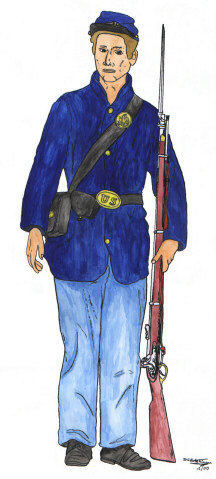
The water color drawings (right) by the author represent the early and later style 31st Indiana V.I. uniforms. Andrew's depiction [Early Uniform] is based on the larger portrait of him and shows him with a navy blue 9 button blouse, navy blue forage cap and trousers.
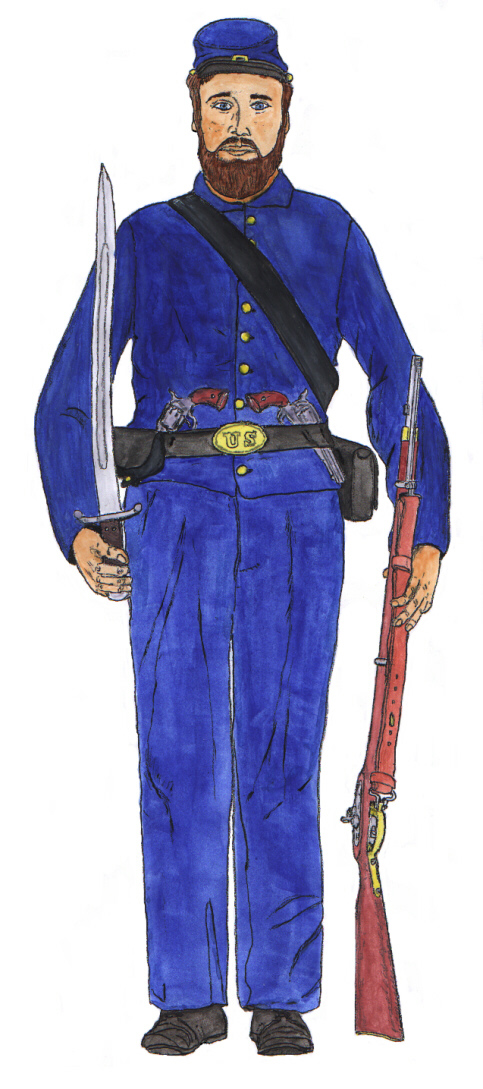
Early Uniform
Later Uniform
© 2001 - 2024 Dennis Hutchinson
This early uniform style is supported by the following which was reported in the Daily Wabash Express on September 21st 1861;
Camp Vigo. -- The Thirty-First Regiment received a portion of their clothing on yesterday. The caps, shoes, socks, shirts &c., were received in the morning and distributed to the men before two o'clock P.M. At dress parade the whole line turned out, in uniform -- consisting of dark blue pants and blouses -- and the line of battle presented a very fine appearance. At the close of the parade the entire line honored their Colonel with three hearty cheers and a tiger. Things are working well at Camp Vigo. The Thirty-First is now entirely full -- except a portion of the Regimental Band. The Forty-Third has five companies, nearly full, in the encampment, and will now rapidly fill up.
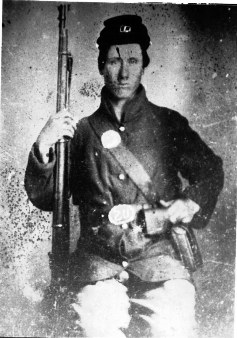
The above water color drawing on your right [Later Uniform] was made using a photo of Chesley F. Leake. The photo was taken in 1862. The fatigue blouse or sack coat is a dark navy blue while the pants are a light sky blue. This drawing represents the typical dress of the 31st Indiana Volunteer Infantry Soldier during the later years.
Chesley was recruited in August of 1862. He wears a forage cap, much like Andrew's above, a 4 button sack coat, US oval belt buckle, a brass eagle badge on the cartridge box leather shoulder strap, and an Enfield cartridge box and cap pouch. He is holding an Enfield Pattern 1853 Rifle-Musket which close to 90% of the regiment was issued. I believe this to be the typical (later) uniform, beginning in the year, 1862 through the end of the war.
Chesley died January 14th, 1864 due to "congestive fever" at the City Hospital in Indianapolis, IN. [2]
Chesley Franklin Leake
31st Indiana Co. A
Later Style of Uniform
Did they wear Shoes or Boots?: Shoes also called brogans or booties would have been the normal footwear issued by the Army to the enlisted men. Boots could have been sent by the soldiers family to him in the field or if he had the monetary means, he could purchase boots on his own. Officers would have been more likely to have had boots than enlisted men since they were more likely to be financially able to purchase them.
Hats or Caps?:
Initially the men were issued Forage Caps as above, and as late as August of 1862, they were still receiving Forage Caps. However, beginning in the warmer weather of 1862, some Diaries report receiving "hats" and some mention purchasing a "hat". The "Western" soldier preferred the "hat" that would protect him from the effects of the sun and rain. Most were farmers and were used to their hats and could have had their old favorite sent to them. There are many photos of "Western" soldiers with hats, but unfortunately I do not have photos of a 31st Indiana private with a "hat". There are some photos of officers having a hat and others wearing a Kepi.
From the existing photos that I do have of 31st Indiana soldiers, it is clear that a variety of, shoes or boots, caps or hats, trousers, coats and jackets existed in the Regiment. One can not
say that one particular style of anything was THE
style worn by the Regiment. There is another style of coat that appears in several of the photos I do have. The coat has 3 lines of stripes at an angle near each cuff on both officers and enlisted men.
Photos of 31st Indiana Soldiers with their Muskets: I have only found 3 photos of 31st Indiana Soldiers posing with their muskets in my collection of 123 individual photos of 31st Indiana Volunteer Soldiers.
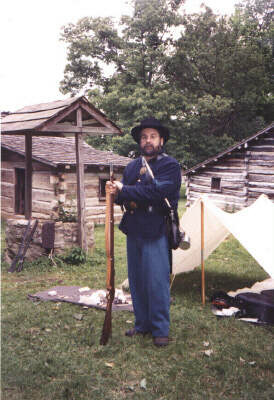
Since we've been discussing Uniforms and Arms of the regiment, here is a picture of this Web site's author. This photo was taken at the Lincoln Pioneer Village in Rockport, IN during a Living History presentation for the 5th grade. I have in hand my trusty Enfield while wearing a 4 button sack coat, "J.T. Martin" pattern. I consider this to be mid 1862 through 1865 garb. My good wife has sent me my comfortable hat.
[1]. Thomas K. Bacon - The Arms and The Man,
by LowelI J. Wagner, Date unknown.
[2]. Letter to Chesley F. Leake's wife, Mrs Saphfroney Leake from Capt. Stephen Martin, Capt. 109th
Co 1st Bat I. V., dated January 15th, 1864.
created with
Website Builder Software .